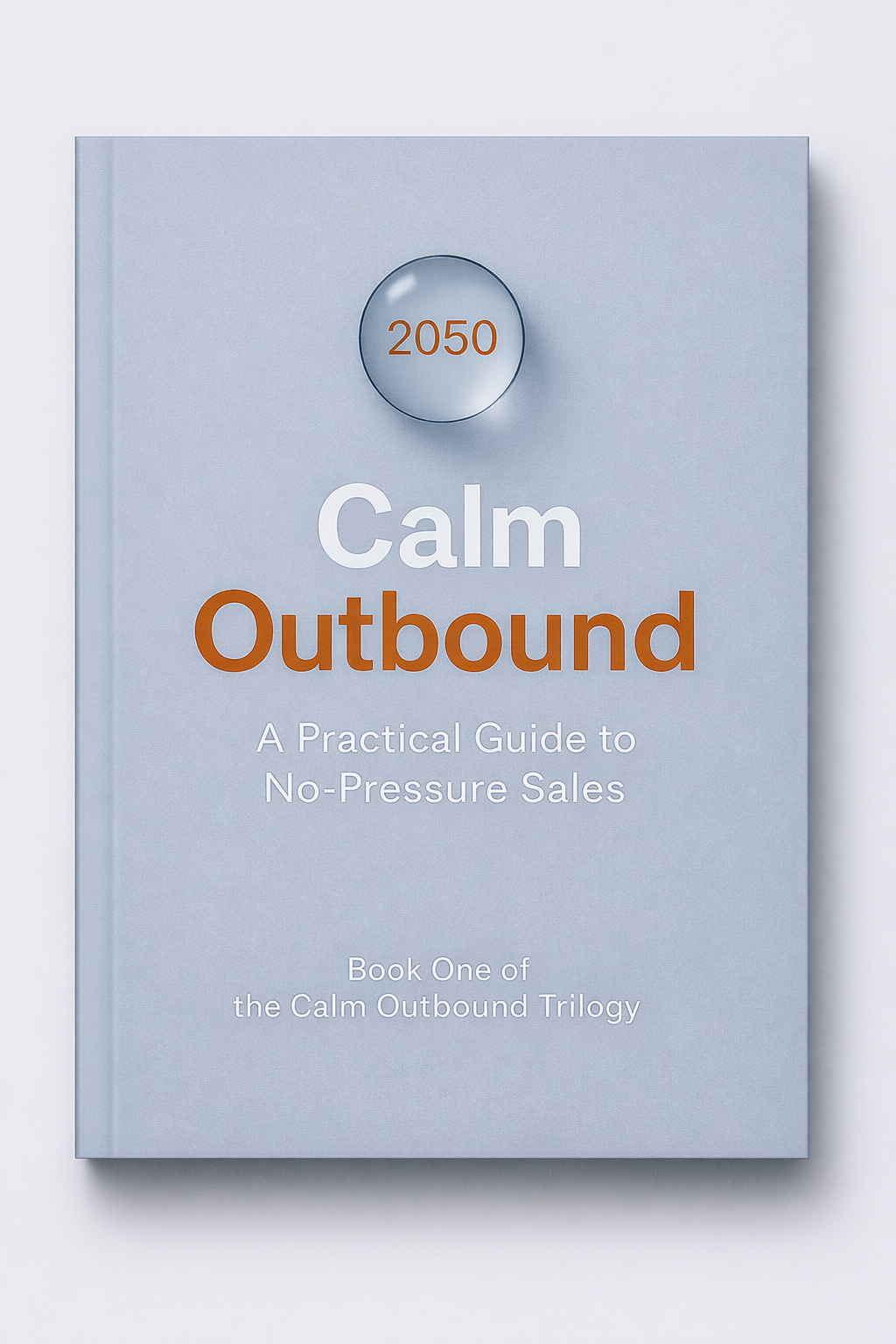
A practical system for selling without pressure, scripts, or burnout.
A 3-book trilogy – plus workbooks – for BDRs, SDRs, and AEs who want consistent results without stress, gimmicks, or noise.
Who Calm Outbound Is For
Calm Outbound is for sales professionals who:
• Want to perform consistently without hype or pressure
• Are tired of scripts that don’t sound like them
• Prefer clarity over hustle culture
• Want a system they can actually run every week
• Care about long-term career health, not just short-term wins
This is not a motivation product.
It’s a working system.
What You Get
The Calm Outbound Trilogy
Book 1 — A Practical Guide to No Pressure Sales
Install calm identity, remove internal pressure, and reset how outbound feels.Book 2 — Building a Sustainable System
Build a repeatable outbound operating system: messaging, sequences, workflows.Book 3 — Mastery
Presence, conversational intelligence, and advisor-level selling.Plus:
Three matching workbooks to turn each book into real-world practice.
This is not theory.
It’s designed to be used.
Why This Works
Calm Outbound was built over years of real outbound work — trial, error, refinement, and repetition.
It consolidates patterns that consistently work across roles, industries, and experience levels — without relying on pressure or personality.
The system favors:
• Clarity over cleverness
• Consistency over intensity
• Trust over tricks
It’s designed to hold up on your worst day — not just your best one.
How People Use Calm Outbound
Most readers use Calm Outbound in one of three ways:
• As a daily or weekly outbound operating system
• As a reset when outbound starts to feel heavy
• As a reference during calls, sequences, or pipeline reviews
You don’t need to “finish” it to benefit.
You install it and run it.
A Simple Guarantee
If you don’t agree that Calm Outbound saves you time, reduces frustration, and improves how outbound feels and performs, you can request a full refund.
No hoops.
No justification required.
You can keep the materials.
This system is meant to help — not trap.
Free Sample
Calm Outbound
BOOK 1 — A PRACTICAL GUIDE TO NO PRESSURE SALES
Table of Contents
- Introduction — Why Outbound Feels So Heavy
- Chapter 1 — Before the First Call
- Chapter 2 — The Real Reason Outbound Feels Hard
- Chapter 3 — The Noise → Clarity → Next Step Model
- Chapter 4 — The Calm Outbound Opening Sequence
- Chapter 5 — The Calm Outbound CTA System
- Chapter 6 — Handling Objections Without Pressure
- Chapter 7 — Alex’s First Breakthrough Calls
- Chapter 8 — The Conversation Flow Map
- Chapter 9 — The Inner Shift: From Fear to Calm Presence
- Chapter 10 — Your First Calm Outbound Plan
- Epilogue — Bridge to Book 2: Systems, Not Just Courage
A Note on the Calm Outbound Workbooks
This book is part of the Calm Outbound trilogy. Each book has a matching workbook
designed to help you actually run the process, not just understand it.
Book 1 focuses on identity, mindset, and core conversation moves.
Workbook 1 gives you the worksheets, call logs, and practice pages to turn those ideas into
real behavior on the phone, in your inbox, and in your CRM.
Inside this book you’ll see short “Practice / Apply” prompts at the end of each chapter.
They’re meant to be quick entry points — things you can do in a few minutes.
If you want structured templates, deeper reflection, and a place to track your reps over time,
that’s what the Calm Outbound Workbook 1 — Practical Guide to No-Pressure Sales is
for. Think of this book as the map, and the workbook as the trail journal you carry with you.
Introduction
Introduction — Why Outbound Feels So Heavy
Most people don’t enter sales because they love interrupting strangers. They enter because
they want growth, opportunity, freedom — and because they want to help people make
good decisions. But somewhere between the goal and the job, outbound becomes heavy.
Scripts sound unnatural. Calls feel like pressure. Rejection stings. And the fear of “not
knowing what to say” grows louder than the desire to reach the goal.
Alex understood this weight well. Standing at the threshold of the first real sales role, the
excitement of possibility was wrapped tightly around a fear: What if I’m not cut out for this?
Outbound felt like a test of confidence more than a skill. A world of people with more
experience, more charisma, more answers.
But outbound is not about charisma. It’s not about clever lines. It’s not about pressure. It’s
about clarity — the kind that cuts through noise and helps people see something more
clearly than they did before.
This book is the beginning of that path. The path from fear to neutrality. From tension to
calm. From trying to “sound like a salesperson” to learning how to speak like an advisor.
“Outbound becomes simple when you stop trying to win the conversation
and start trying to clarify it.”
Book 1 lays the foundation and provides a guide: mindset, clarity, calm openings, soft CTAs,
and objection navigation without pressure. Book 2 builds the systems. Book 3 gives you
mastery. Together, they form the Calm Outbound trilogy — a new way of selling that feels
human, steady, and refreshingly natural.
Let’s begin where Alex began: right before the first call, where everything still feels
uncertain — and where the path forward starts to become clearer.
Chapter 1 — Before the First Call
The cursor blinked at Alex Carter from the top of a spreadsheet that felt a lot heavier than it
looked.
Two hundred and fifty names. Titles like “VP of Operations,” “Director of IT,” and “Head of
Revenue.” A mix of phone numbers and email addresses that the sales ops team cheerfully
called “fresh ‘marketing qualified leads’.”
It did not feel fresh. It felt like a stack of unopened exam results.
Alex took a sip of rapidly cooling coffee, put the headset on, and stared at the dialer queue.
Scripts sat in a binder to the left, highlighted and tabbed — the official talk track the
company had “seen success with.”
They sounded fine on paper. They felt horrible in Alex’s mouth.
“If I sound like this on a live call,” Alex thought, “I’ll hate this job and they’ll hate me.”
On the whiteboard at the front of the room, the day’s goals were written: dials,
conversations, meetings booked. At the bottom, in a different color: “Outbound =
Opportunity. Outbound = Options.”
Alex didn’t understand that yet. Outbound meant calls. Calls meant anxiety. Anxiety meant
more coffee.
What Alex didn’t know — what this book is going to show you — was that outbound
doesn’t have to feel fake, pressured, or performative.
Outbound doesn’t require charisma.
Outbound doesn’t require clever lines.
Outbound doesn’t require pretending to be someone you’re not.
Before the first call of the day, Alex did something small that changed everything: pushed
the binder of scripts to the side, opened a blank notepad, and wrote one line:
“What would I actually say if I wanted to be genuinely helpful?”
You don’t need to be a natural salesperson to make outbound work. You need a system that
matches how real humans communicate.
The hardest part of outbound is often not the call itself. The hardest part is the moment
before the call. That moment when the cursor hovers over the dial button. Heart rate slightly up. Thoughts
racing. In that moment, a quiet story plays in the background:
“I’m about to interrupt someone.”
“They probably don’t want to hear from me.”
“If this goes badly, maybe I’m not cut out for this.”
The fear is not just rejection. The fear is what rejection might mean.
Calm Outbound starts before the first dial. It starts in the way you think.
And so Alex did what every seller must eventually do: take a breath, lift a finger, and make
the first call — not with certainty, but with openness.
The call did not go perfectly.
But it didn’t have to.
Alex had begun.
What Alex didn’t realize yet was that the call wasn’t the source of the fear — and Chapter 2
begins with that discovery.